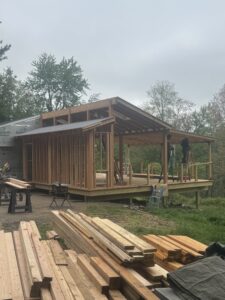
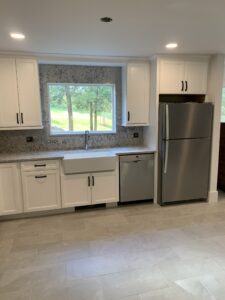
At some point, most homeowners who feel like they have outgrown their house ask the same question: is it smarter to add on, or to sell and buy something bigger. There is no single right answer, but there is a clear way to think through it.
The Real Cost of Moving in the Hudson Valley
Moving looks simpler on paper, but the actual cost adds up quickly. Realtor commissions typically run 5 to 6 percent of the sale price. Add closing costs on both the sale and the purchase, a mortgage rate that may be higher than the one you currently hold, moving costs, and the time spent searching for a property that actually meets your needs in a competitive Hudson Valley market. On a $500,000 home, commissions and closing costs alone can easily reach $40,000 to $60,000 before you have even purchased the next house.
There is also the matter of what you are buying into. A home that checks every box on space rarely checks every box on location, schools, land, or character, particularly if you are trying to stay in the same Ulster County town you already know and value.
The Real Cost of Adding On
A home addition is a significant investment, typically $150,000 to $450,000 depending on scope, as we cover in our Home Addition Cost Guide for Ulster County. That is real money, but it buys space in a house, a neighborhood, and a location you have already chosen deliberately. It also lets you keep whatever mortgage rate you currently hold, which has become a meaningful factor for many homeowners weighing this decision.
When Adding On Makes More Sense
- You like where you live. If the location, land, schools, and community are right and the house is the only thing that is not, an addition solves the actual problem.
- You have a favorable mortgage rate. Trading a low fixed rate for a new mortgage at current rates can cost more over time than the addition itself.
- The lot supports it. If zoning and setbacks allow for the space you need, building is often more cost-effective than the combined cost of selling and buying. Our guide to home addition permits in Ulster County covers what determines whether your lot qualifies.
- You need specific space, not more of everything. An addition can target exactly what is missing, a primary suite, an in-law arrangement, a larger kitchen, rather than paying for square footage you do not need in a new house.
When Moving Makes More Sense
- Your lot cannot accommodate the addition you need. Zoning, setbacks, septic capacity, or lot size sometimes rule out the scope of project you are picturing.
- The house has issues beyond square footage. Foundation problems, an outdated layout that cannot reasonably be reworked, or a location that no longer fits your life are not solved by an addition.
- The math genuinely favors buying. In some cases, particularly if your current home has appreciated significantly and the next house is priced favorably, buying can come out ahead. This is worth running as real numbers, not assumptions.
A Straightforward Way to Compare
Get a realistic estimate for the addition you actually want, including design and permitting, and compare that total to the real cost of selling your current home and buying a comparable one with the space you need, including commissions, closing costs, moving costs, and any difference in mortgage rate. For most Ulster County homeowners we work with who are happy with their location, the addition comes out ahead, both financially and in terms of avoiding the disruption of a move.
How We Help With This Decision
Before committing to a full design process, we can walk your property with you and give you a realistic sense of what is feasible on your lot and roughly what it would cost. That is often enough information to make the addition-versus-move decision with confidence, before either an architect or a real estate agent gets involved.
Frequently Asked Questions
▸Does an addition always pay for itself at resale?
Well-designed additions that match neighborhood expectations, like an added bedroom or bathroom, typically recoup a strong portion of their cost. Additions that are out of scale with the surrounding market recoup less. This is different from the moving-versus-adding decision itself, which is about your near-term cost and disruption, not only resale value.
▸How do I know if my lot can support an addition?
Setbacks, lot coverage limits, and septic capacity all factor in. We can typically give you a preliminary read during an initial site visit, before any design fees are involved.
▸Is it faster to move or to build an addition?
It depends on the local real estate market and the scope of the addition. A well-planned addition can often be completed in less time than the combined process of listing, selling, searching, and closing on a new home in a competitive market.
Weighing an Addition Against a Move?
We’ll walk your property and give you a realistic read on cost and feasibility before you decide, no design fees required.